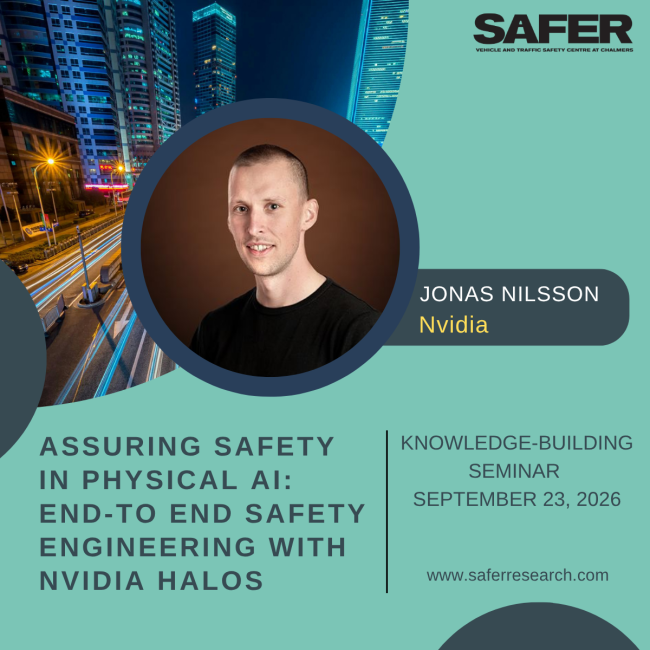
SAFER Seminar with Jonas Nilsson: Assuring Safety in Physical AI: End-to End Safety Engineering with NVIDIA Halos
SAFER is pleased to welcome Jonas Nilsson, Director of Safety Engineering and Head of AV Safety at NVIDIA, for a special seminar on the emerging safety challenges as AI moves from the digital world into autonomous vehicles and other physical systems.
Jonas will share perspectives from NVIDIA’s work on safety engineering for physical AI, including how safety needs to be addressed continuously across the data-driven development lifecycle. Drawing on NVIDIA Halos, he will discuss safety guardrails ranging from end-to-end AI models to methods for measuring safety performance at scale – and what this means for the development and assurance of increasingly AI-driven automated driving systems.
The seminar is also a unique opportunity to meet Jonas and discuss where the field of automated driving safety is heading, the challenges that remain, and how safety engineering needs to evolve alongside increasingly capable AI systems.
Following Jonas’ presentation, we broaden the discussion in a panel bringing together complementary perspectives on AV safety, safety assurance, real-world evidence and human interaction with automated systems.
Yiannis Papadopoulos, University of Hull, contributes extensive expertise in safety engineering, safety assurance and the certification of complex autonomous systems; Jonas Bärgman, Chalmers University of Technology, brings a strong research perspective on safety evaluation, focusing on the data, methods and evidence needed to determine whether automated driving systems actually deliver improved safety; and Linda Pipkorn, Chalmers University of Technology, contributes expertise in human–automation interaction, with a particular focus on how drivers interact with assisted and automated driving systems.
Together, the seminar and panel will explore a central question for the field:
What does it actually take to make automated driving safe in the real world – and how do we know when it is safe enough?
The event is hosted by Christian Berger, University of Gothenburg. Welcome to join the discussion!
This event is for partners only!
Agenda:
09:30–10:00
Coffee, cinnamon rolls and networking – an opportunity to meet Jonas and other participants
10:00–10:15
Welcome and introduction by Christian Berger, University of Gothenburg
10:15–11:00
Keynote by Jonas Nilsson, NVIDIA: Assuring Safety in Physical AI: End-to End Safety Engineering with NVIDIA Halos
11:00–11:30
Panel discussion: What does it take to make automated driving safe in the real world?
With Jonas Nilsson, Yiannis Papadopoulos, Jonas Bärgman and Linda Pipkorn, moderated by Christian Berger.
11:30–11:45
Closing remarks
Register here prior to Sep 21 lunch time.
Abstract for Jonas' talk
As AI transitions from digital spaces into the physical world, novel safety challenges arise for autonomous vehicles, robotics, and intelligent physical systems. The unprecedented speed of modern AI development creates an urgent need for continuous safety engineering innovation across the data-driven ecosystem. This session explores these critical challenges and discusses how to address them using NVIDIA Halos, a comprehensive safety system for physical AI applications. After the introduction, we'll walk through safety guardrails across the development lifecycle, spanning from guardrails for E2E AI models to measuring safety performance at scale.
Bio for Jonas Nilsson
Jonas Nilsson leads the Autonomous vehicle safety team at Nvidia. The team's mission is to enable AI-powered automated driving and ADAS in mass-produced vehicles around the world, by delivering best-in-class safety assurance. This includes but is not limited to safety architecture, AI safety, systems and safety engineering processes and tools, safety management, safety culture, safe continuous delivery, safety metrics, safety verification at scale using data and simulations, industry best practices, compliance with safety standards (e.g. ISO 26262, ISO 21448, ISO/PAS 8800).
Between 2007 and 2017 he was with Volvo Cars, initially developing verification methods for active safety systems and from 2014 leading safety assurance of self-driving vehicles. In 2017, he joined Zenuity, a newly formed joint venture of Volvo Cars and Veoneer, as the technical lead for automated driving safety. He received a Ph.D. in Mechatronics from Chalmers University of Technology, Gothenburg, Sweden, in 2014.