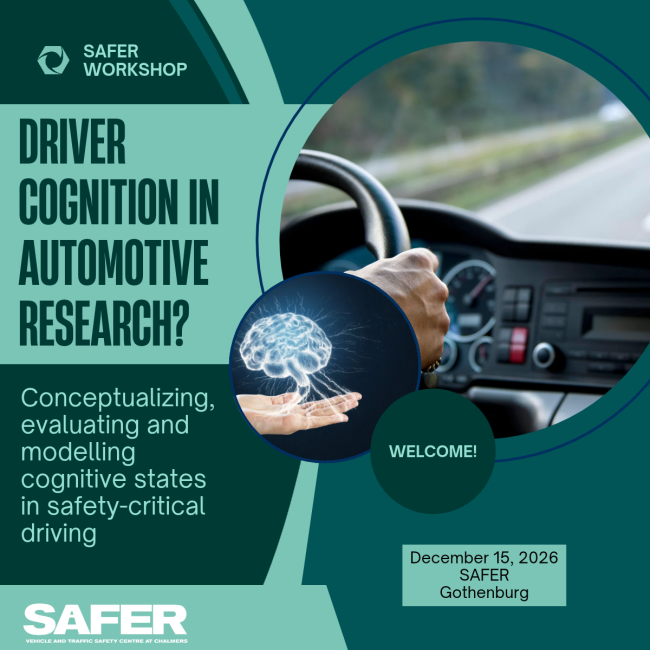
Workshop: Driver cognition in automotive research?
Welcome to a workshop, organised by SAFER's working group on Road User Behaviour:
Driver cognition in automotive research? Conceptualizing, evaluating and modelling cognitive states in safety-critical driving.
Utilizing well-conceived methodologies and modelling practices for conceptualizing and evaluating cognitive, or cognitive-related, phenomena in drivers, such as (in)attention and cognitive load, is a key area of traffic safety research. It is essential for both ecologically-relevant explanations of behaviour and for enabling adaptive responses in vehicles using driver support systems. Modelling components of cognitive states also requires appreciation of exactly what data may be relevant to behaviour, which poses challenges for methodologies focusing on controlled set-up and more ecologically "wild" simulation studies. Even with appropriate conceptualization and evaluation of such cognitive phenomena, it may also be questioned to what extent such states affect traffic safety at all.
This workshop will bring together researchers and practitioners from academia and industry to discuss methodologies for evaluating theories, models and the relevance of cognitive states and related phenomena in safety-critical driving scenarios. The event will include presentations on evaluations, methodologies, modelling approaches, and empirical studies assessing cognitive phenomena in drivers in passenger vehicles and even non-passenger vehicles.
A workshop activity will focus on participant groups discussing methodologies and methodological pipelines they consider most appropriate for specific cognitive phenomena, including but not limited to attentional states and cognitive load.
The workshop aims to identify shared evaluation principles across cognitive phenomena, clarify methodological and modelling limitations, and to establish priorities for future research.
Schedule:
0900-0915 Introduction: Robert Lowe, SAFER "Road User Behaviour" group, RISE/University of Gothenburg.
0915-1000 Otto Lappi, University of Helsinki: "Ecological Approach to Cognitive Science - Ten Simple Principles"
To understand human behavior 'in the wild', both real-world and laboratory data are necessary. However, as they call for quite different analysis methods and theoretical concepts, it is not straightforward to bring them together into a coherent empirical foundation.
In this talk, I highlight ten 'simple principles' to follow (really, methodological and theoretical challenges to meet) that can be used to guide experimental and theoretical work on naturalistic tasks, and to assess the 'ecological validity' or studies or entire research programmes.
Examples are provided from my work on everyday and expert performance in driving.
1000-1045 Mikael Ljung Aust, Volvo Cars: "Cognitive load does not matter for traffic safety"
1045-1105 Networking/fika break
1105-1145 Activity
Group work concerning designing methodological pipelines, analytic approaches (biometrics etc.), and modelling frameworks for the study and detection of safety-critical cognitive states in driving. Each group to list:
- Relevance of two cognitive phenomena (often studied in traffic safety research) to i) safety, ii) well-being, and potential ADAS support for both.
- Challenges of measuring and/or modelling these cognitive phenomena using behaviour, biometrics, other modalities (e.g. speech, subjective reporting) in controlled and real-world settings.
- Priorities for future research for monitoring cognitive states in passenger and non-passenger vehicles.
1145-1240 Lunch
1240-1325 Marco Dozza, Chalmers: "Preventing intoxicated riding with intelligent technologies".
This talk presents ongoing research aimed at enabling real-time detection and prevention of alcohol-impaired micromobility riding. Using data from two controlled experiments, one conducted in an advanced riding simulator and the other on an indoor test track, participants performed a range of riding tasks while sober and at two levels of alcohol intoxication. The studies combined motion capture, eye tracking, and vehicle-mounted inertial sensors to identify measurable signatures of impairment in both rider behaviour and vehicle dynamics. Preliminary results show that impairment-related changes can be detected from multiple sensing modalities and that combining eye-tracking measures with kinematic data substantially improves classification performance compared with using vehicle dynamics alone. The ultimate goal is to support the development of two complementary safety systems: a vehicle-based system that can detect impairment directly from onboard sensors and intervene when necessary, and a site-based system that can identify impaired riders within the riding environment and support preventive actions before a crash occurs. Together, these developments represent an important step toward scalable technologies that can reduce the risks associated with intoxicated riding.
1325-1410 Emma Nilsson, Volvo Cars "Cognitive state estimation using physiological measures"
1410-1430: Summary by Robert Lowe
1430-1500: Fika & Networking
Welcome to register here prior to December 10 (SAFER partners only!)!