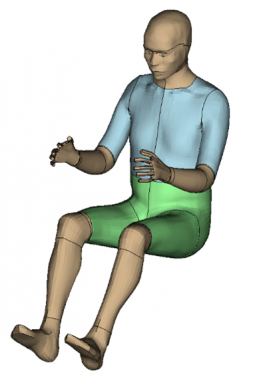
SAFER Human Body Model – now a global resource for faster traffic safety innovation
SAFER HBM is a virtual Human Body Model (HBM) – a digital human body used in computer simulations to predict how people move and may be injured in traffic crashes. Developed through long-term collaboration between Chalmers University of Technology, Volvo Cars and Autoliv, it has for years been used as an internal capability. Now, SAFER HBM is taking the next step: becoming available for global use, opening up new possibilities for faster, more detailed and more scalable traffic safety development, worldwide.
The strength of an HBM is that it can complement and enhance physical crash tests and crash test dummies by enabling virtual testing of many more scenarios, earlier in the development, and with richer insight into body response and injury risk. This becomes increasingly important as modern safety increasingly depends on integrated systems – where events before impact (like braking and evasive manoeuvres) influence occupant posture and the crash outcome.
Recognised as SAFER’s most groundbreaking innovation
Since SAFER’s start in 2006, the platform has been designed to bring partners together to create knowledge and solutions that go beyond what any single actor can achieve alone. Within SAFER’s long-term capability building, human body modelling has been one of the centre’s particularly strong areas. That long-term, collaborative build-up is exactly what has enabled SAFER HBM to mature into a robust, research-based tool that partners can trust in advanced safety development.
In 2021, the SAFER HBM cluster of projects received SAFER’s 15-year anniversary prize, awarded for being the most groundbreaking project in the research and competence centre’s history as voted by the partners.
What SAFER HBM enables – benefits and future opportunities
With SAFER HBM, safety developers and researchers can:
- Accelerate development by exploring more scenarios virtually and earlier, reducing reliance on only physical testing.
- Improve decision-making with deeper insight into human kinematics and injury risk, supporting better design of restraint systems and integrated safety solutions.
- Enable broader collaboration and comparability, as more organisations can work with the same advanced tool and build shared knowledge and methods.
As SAFER HBM moves from an internal platform capability to broader access, it also creates momentum for new collaborations, validation efforts, and innovative applications across the wider road safety ecosystem.
How it becomes globally available
SAFER HBM is further developed and brought to market via the Fraunhofer-Chalmers Centre (FCC), together with the founding organisations Chalmers, Autoliv and Volvo Cars – making it possible for users beyond SAFER’s partner circle to benefit from the tool.
Contact: Prof. Bengt Pipkorn, Fraunhofer-Chalmers Centre (bengt.pipkorn@fcc.chalmers.se)